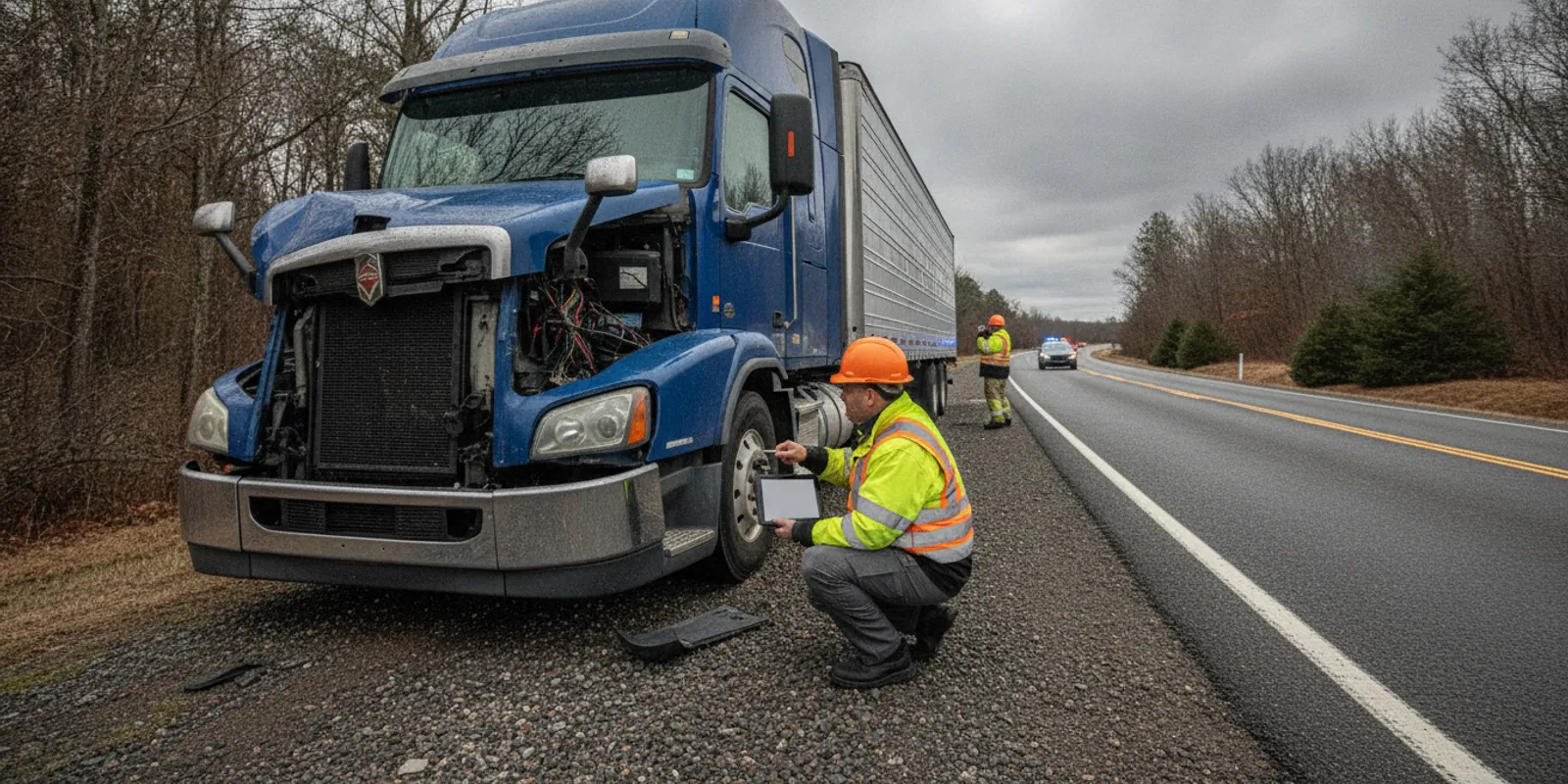

After a serious truck collision, it can be difficult to know what happened in the moments before impact. Truck accident black box evidence Ontario claimants may hear about can include electronic records from the truck, but there is no single device that captures every detail. Understanding what may exist, why it matters, and how quickly it may need to be preserved can help injured people and families make informed next-step decisions.
Request a free consultation with Hoffman Law
What does “black box” mean after a truck collision?
“Black box” is a convenient phrase, not necessarily the name of one standard truck device. A commercial vehicle may have several electronic systems that record different kinds of information. Some information is stored in the truck itself. Other records may be held by a trucking company, a fleet-management provider, a dashcam vendor, a shipper, or another third party.
Depending on the vehicle and systems in use, relevant records may include:
- Event data from vehicle systems: Some vehicles may store limited information associated with a sudden event, such as a collision or hard braking. The data available can vary by make, model, system, configuration, and event.
- Electronic logging device (ELD) records: These systems are used to record a driver’s duty status and related information. They may help establish a timeline, but they do not necessarily provide a complete picture of the truck’s movements or the collision itself.
- Telematics and fleet tracking: A carrier or service provider may keep location, route, speed-related, vehicle-use, or diagnostic information. What is recorded and how long it remains available depend on the system and the operator’s practices.
- Dashcam or other video: A camera may face the road, the cab, or both. Video can be overwritten, retained for a limited period, or unavailable if the vehicle did not have a recording system.
- Dispatch and delivery records: Work assignments, route instructions, timestamps, and communications may help explain where the driver was expected to be and what was happening during a trip.
- Maintenance and inspection records: Service histories and reported defects can provide context about the vehicle’s condition. These are not necessarily stored in an electronic black box.
These records are not interchangeable. A location log may help establish where a truck travelled, while a camera may show the roadway and an event-data record may contain limited vehicle information. No one record should be assumed to tell the whole story.
Why can electronic truck data matter?
Electronic information can help test or clarify accounts of a collision. A driver, another road user, and a witness may remember events differently, especially after a frightening impact. Records created independently of a later dispute can help investigators build a more precise timeline, when the records exist and can be interpreted reliably.
Depending on what was recorded, data may help answer questions such as:
- Where was the truck travelling before the collision, and when?
- Did its route or stopping pattern differ from what someone described?
- Was there a sudden vehicle event before or during the impact?
- What do available records indicate about the timing of a trip or a driver’s work period?
- Were there warnings, reported defects, or maintenance issues that deserve further investigation?
- Does available video show road conditions, traffic movements, or the sequence of events?
The answer to any one of these questions may be incomplete. For example, a system may record a short interval, omit certain data, or use measurements that require technical interpretation. A data point should be considered alongside physical evidence, witness accounts, photographs, medical information, and other records. The purpose is not to treat an electronic record as automatically conclusive, but to see whether it supports, complicates, or contradicts another part of the evidence.
A Wisconsin Court of Appeals decision concerning a particular semi-truck described a device that stored data from only the three most recent sudden-deceleration events. That example is not an Ontario legal rule or a description of every truck. It illustrates why it is important to identify the specific vehicle and system rather than assume that a “black box” contains a complete recording of a collision. Read the court decision describing that device.
Which records might be available after a truck crash?
The records worth asking about depend on the collision and the truck involved. A useful first step is to identify the types of evidence that may exist and who may control them. Not every category will apply to every case, and the presence of an electronic system does not guarantee that it retained relevant information.
| Record or source | What it may help establish | Important limitation |
|---|---|---|
| Vehicle event data | Limited vehicle information connected to a recorded event | Availability, duration, and recorded variables differ by system and vehicle. |
| ELD or duty-status records | A timeline of recorded driver duty status and related entries | It is not necessarily a second-by-second location record or a full account of the collision. |
| Telematics or fleet tracking | Possible location, route, vehicle-use, or diagnostic information | Providers and carriers may use different systems and retention practices. |
| Dashcam footage | Possible visual evidence of the road, traffic, or activity in the cab | There may be no camera, relevant footage may not exist, and video may be overwritten. |
| Dispatch and trip documents | Route, task, timing, and communications context | These records may be held by different people or companies and may not describe what occurred on the road. |
| Maintenance, inspection, and repair records | Vehicle condition, reported issues, and work performed | Records require context; an entry alone does not prove that a defect caused a collision. |
Other evidence may be just as important. This can include scene photographs, measurements, roadway or nearby business video, witness contact details, police or incident documentation, vehicle damage, and medical records. For a serious injury, treatment notes and information about changes in daily function can also help document the consequences of the collision. If a collision involved a truck and you need general immediate steps, see Hoffman Law’s guide on what to do after a car accident.
Why does preserving truck data require prompt attention?
Electronic records can be vulnerable to loss. A system may retain only a limited period, record over older information, or store information with a company or service provider that is not at the collision scene. A truck may be repaired, returned to service, transferred, or have components changed. Video systems may also use automatic overwrite cycles. These possibilities make early identification and preservation important.
There is no single retention period that can safely be assumed for every record. The period may depend on the particular equipment, settings, operator, service provider, and type of information. Some records may remain available for a while; others may be overwritten or become harder to retrieve. Do not assume that a record will be kept simply because a collision was serious or because a claim may follow.
Preservation is not the same as proving what happened. It is an effort to prevent potentially relevant material from disappearing while the facts are investigated. Depending on the situation, a lawyer may assess who controls the records and what steps are appropriate to request that they be retained. This can involve identifying the carrier, vehicle, systems, and relevant time period as accurately as possible.
People who have just been injured should not put themselves at risk trying to collect data from a truck, enter a vehicle, or confront a driver or company. Focus first on immediate safety and medical care. If you are able, keep your own notes about the collision and preserve information already in your possession. Legal guidance can help address communications and evidence requests without requiring an injured person to manage a complex investigation alone.
What can injured people and families do?
There is no need to know the technical name of a device before asking whether electronic evidence may exist. These practical steps can help preserve what you know and support a later review:
- Get medical care and follow up. Your health comes first. Explain your symptoms to your care providers and seek follow-up if problems change or continue. Keep copies of relevant appointments, instructions, and expenses where practical.
- Write down what you remember. When you are able, record the date, approximate time, location, direction of travel, weather and road conditions, and what you recall before and after impact. Memories can become less clear over time. Mark estimates as estimates rather than presenting them as exact measurements.
- Keep existing evidence in its original form. Save photographs, messages, emails, dashcam files, receipts, and documents related to the collision. Avoid editing or deleting original files. Make a note of where each item came from and when you received it.
- Identify potential witnesses and cameras. If safe and appropriate, note witness names and contact information and identify nearby businesses or locations that may have cameras. Do not assume footage will be retained; simply make a record of the lead for follow-up.
- Keep truck and company details. Write down the licence plate, company name, unit number, trailer details, and any visible identifying information, if available. Police or other records may contain details you did not capture at the scene.
- Avoid guessing about technical records. Do not rely on a general online description of a black box to conclude that a certain speed, braking action, or driver activity was recorded. The relevant equipment and data need to be identified and interpreted in context.
- Ask for legal guidance promptly if the injuries are serious. A lawyer can help assess liability issues, potential evidence sources, insurance questions, and what steps may be needed to preserve records. Hoffman Law handles motor vehicle accident claims in Ontario, including serious collisions.
These steps are general information, not a substitute for legal advice about a particular collision. A person who is still receiving treatment, dealing with a disability, or helping a family member may have limited time and energy. It is reasonable to ask someone trusted to help keep documents organized, make a list of questions, or attend a consultation.
How is electronic data assessed alongside other evidence?
Collecting a file is only one part of the process. The next questions are whether it is complete, what system created it, what the fields mean, and whether the relevant time period is included. Specialists may be needed to preserve or interpret some technical evidence. The appropriate approach depends on the source and the issues in dispute.
A careful review can compare a data record with the rest of the evidence. For example, a timestamp might be compared with a dispatch message, a witness account, or a camera recording. A vehicle event entry may be considered alongside damage patterns, photographs, and physical evidence. A maintenance entry may prompt further questions, but it does not automatically establish that a mechanical problem caused the collision. Each piece has to be understood within its limits.
It also matters how the information was obtained and handled. Original files, system details, date and time settings, and the chain of custody may affect how confidently a record can be used. Screenshots or a short excerpt can omit context. If a carrier or third party provides material, a qualified review may help determine whether the material is complete and what it can reasonably show.
Electronic information does not decide fault on its own. A collision claim may involve questions about the actions of multiple road users, vehicle condition, road design or maintenance, and the circumstances of the trip. The evidence available in one case may be different from another. The legal significance of a record depends on the facts and applicable law.
What if an insurer asks for a statement or documents?
After a serious truck collision, you may hear from an insurer or receive requests for information. It can be stressful to respond while you are coping with injuries, treatment, and financial concerns. Keep copies of letters, emails, forms, and notes of calls. If you do not understand a request, ask what it is for and consider getting legal advice before providing a detailed statement or signing documents you do not understand.
Do not speculate about what the truck’s electronic systems show. It is fine to say that you do not know whether a particular system recorded information. Keep factual observations separate from assumptions. If an insurer disputes responsibility or the effect of your injuries, it may be helpful to understand the difference between a liability claim and available accident benefits. Hoffman Law provides information about Ontario accident benefits and brain injury claims.
Hoffman Law is a Toronto-based personal injury and disability firm serving people across Ontario, including North York and other communities. The firm offers free consultations and case evaluations. A consultation can help you understand the questions to ask and whether legal representation may be appropriate; no particular outcome or compensation can be promised. Learn more about how the firm explains its fees and meet the Hoffman Law team.
Contact Hoffman Law for a free case evaluation
Frequently asked questions
Does every commercial truck have a black box?
Do not assume that every truck has the same recording device or stores the same information. A vehicle may have several electronic systems, and their availability and capabilities differ. The specific truck and its equipment need to be identified before anyone can say what data might exist.
Can a truck’s black box prove who caused the collision?
Not by itself in every case. A data record may help establish part of a timeline or provide information about a vehicle event, but it may have gaps and needs context. Fault is assessed by considering the available evidence and the applicable law, not by relying on a device label alone.
How long is truck black box data kept?
There is no universal retention period that applies to every device and record. Storage and overwrite practices can vary by system, carrier, and provider. Because some information may not remain available indefinitely, it is prudent to seek guidance about preservation as soon as reasonably possible after a serious collision.
Can I ask the trucking company for its electronic records?
You can seek legal guidance about how to approach a request, what records to identify, and how to address preservation. The proper route depends on who holds the information, the circumstances, and the stage of the matter. A lawyer can help assess appropriate next steps without assuming that a particular record exists or will be provided voluntarily.
What if the truck’s electronic data is missing?
A missing record does not automatically decide a claim. Other evidence may still help explain how the collision happened and how the injuries affected you. An assessment may consider what information should have existed, who controlled it, and what other sources can help establish the facts.
Discussing a serious truck collision
Electronic truck records can be valuable, but they are only one possible part of a collision investigation. Identifying the systems, acting before information is lost, and comparing records with other evidence can help clarify what happened. If you or a family member has suffered a serious injury in an Ontario truck collision, consider speaking with a lawyer about the evidence and your options.