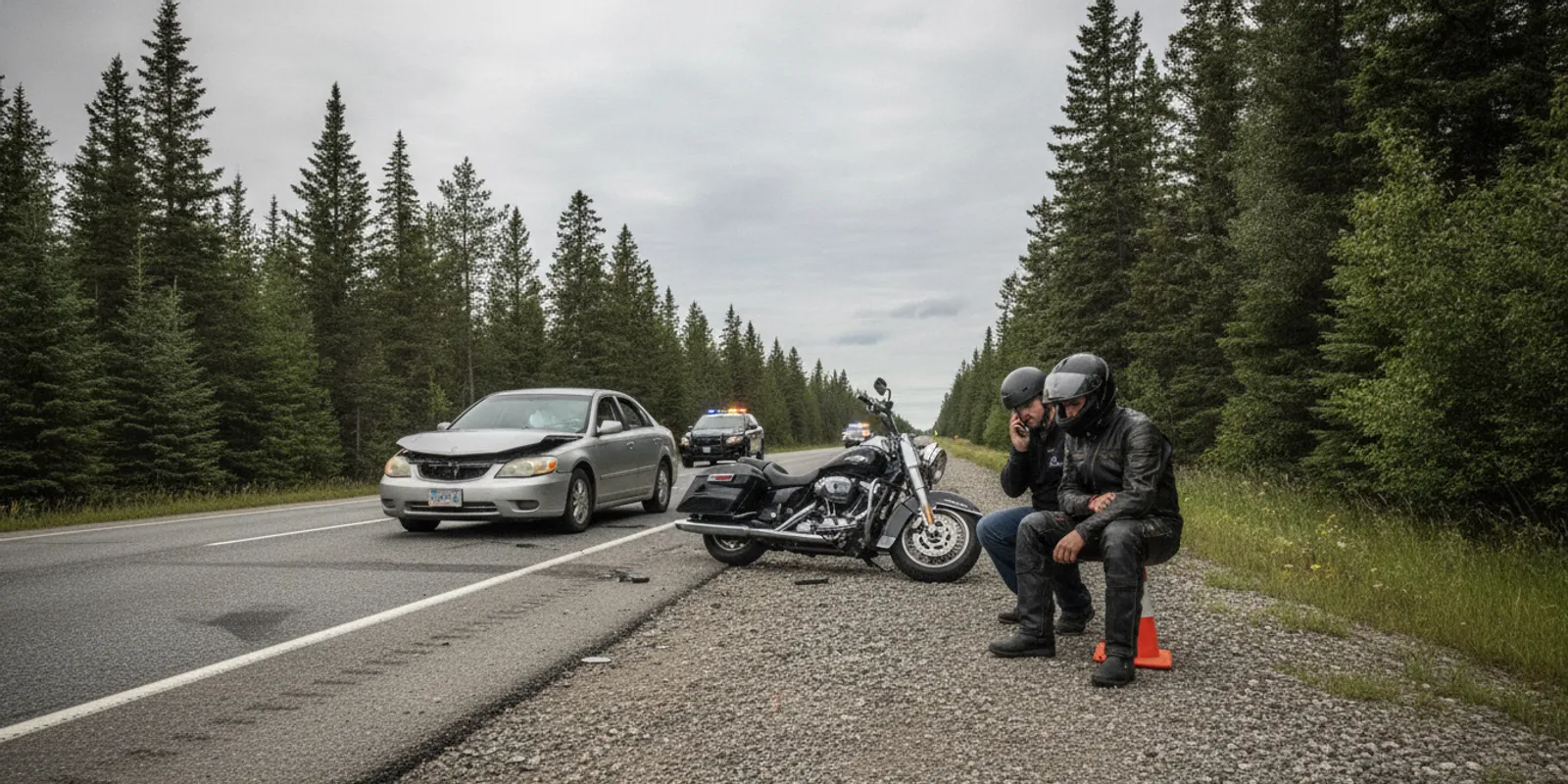

After a motorcycle crash, it can be hard to know who may be held responsible. Motorcycle accident liability Ontario cases can involve more than the rider and the driver of another vehicle. The facts may point to a vehicle owner, employer, road authority, or product manufacturer as well. Understanding the possible sources of liability can help you preserve useful evidence and decide what to do next.
Contact Hoffman Law for a free consultation or case evaluation
What does liability mean after a motorcycle accident in Ontario?
Liability is legal responsibility for harm caused by someone’s conduct. In a motorcycle collision, a claim may ask whether a person or organization failed to take reasonable care and whether that failure caused or contributed to the injuries. A crash alone does not establish who was legally at fault. The available evidence, the road conditions, and the actions of everyone involved matter.
More than one person may share responsibility. For example, a driver might turn across a rider’s path while the rider is also found to have contributed to the collision. A vehicle owner or employer could also become relevant depending on the relationship and circumstances. Fault is assessed on the particular facts, so an early assumption based on who was driving or who was injured may be incomplete.
Liability for a damages claim is also different from access to accident benefits. Ontario’s Statutory Accident Benefits Schedule (SABS) provides benefits through an auto insurer after an accident, subject to eligibility and the applicable rules. A person may have an accident-benefits claim even while fault is disputed. Learn more about accident benefits in Ontario.
Who may be responsible for a motorcycle collision?
Start by considering everyone whose decisions or responsibilities may have affected the crash. The following are possibilities, not automatic conclusions.
The driver of another vehicle
A car, truck, or other vehicle driver may be responsible if their conduct contributed to the collision. Examples can include turning or changing lanes without making sure it is safe, following too closely, failing to yield, driving while distracted, or entering an intersection when it is not safe. Whether any particular act amounts to negligence depends on what happened and the evidence.
Drivers sometimes say that they did not see the motorcycle. That statement alone does not decide fault. Investigators may examine the driver’s sight lines, speed, timing, traffic signals, road layout, and what a reasonable driver should have noticed.
The motorcycle operator
A rider’s actions are also considered. Speed, lane position, visibility, following distance, and response to a hazard may be relevant. But an injury or a disagreement about how the crash happened does not prove that the rider caused it. Evidence should be reviewed before assigning blame.
If a rider is found partly responsible, that does not necessarily end a claim against another at-fault party. Responsibility may be divided according to the facts. The effect of any finding on compensation is a legal question that depends on the claim and applicable law.
The motorcycle or another vehicle’s owner
The registered owner may matter even if someone else was driving. Questions can include who had control of the vehicle, whether it was being used with the owner’s permission, and what legal rules apply to the relationship between owner and driver. Do not assume that ownership by itself proves liability or that only the person behind the handlebars can be involved. An Ontario lawyer can assess the facts and identify the correct parties.
An employer or business
If a driver was working when the crash occurred, the employer or another business may need to be considered. The driver’s role, the reason for the trip, and the relationship with the business can matter. A commercial vehicle, delivery trip, or work assignment can involve insurance and responsibility questions beyond a collision between two private road users.
A road authority or property manager
A dangerous road condition may contribute to a crash. Examples might include a significant surface defect, an obscured sign, poor maintenance, or a work zone that creates an unexpected hazard. A road authority or other party responsible for maintaining the area could be relevant, but proving a claim can require evidence about the hazard, notice, responsibility for maintenance, and how it caused the collision.
Claims involving public property can have special notice and procedural rules. If you believe a road defect or work zone played a role, document it promptly and get legal advice without delay. Do not rely on a general online article to calculate a deadline.
A manufacturer, repairer, or maintenance provider
A mechanical failure may raise questions about a defective component, an improper repair, or inadequate maintenance. Examples might include brake, tire, steering, or lighting problems. A mechanical issue does not automatically establish that a manufacturer or repairer is responsible. The component may need to be preserved and examined, and the chain of maintenance and ownership may need investigation.
After a crash involving a suspected defect, avoid repairing or discarding the motorcycle or damaged part before asking how to preserve it. A product liability claim can involve technical evidence and a different set of questions from a claim against another road user.
How is fault assessed when several people may have contributed?
Investigators and insurers typically consider the whole sequence of events, not just the point of impact. They may compare accounts with photographs, video, vehicle damage, road markings, witness observations, and expert analysis. A police report can be useful, but it is not necessarily a final decision on civil liability.
For example, imagine a car turns left across a motorcycle’s path at an intersection. The car driver’s decision to turn may be important. Investigators may also ask how fast the motorcycle was travelling, whether either person had a clear view, what the signal showed, and whether there was time to avoid the impact. The answers can affect how responsibility is assessed.
Fault can be disputed even when the injuries are serious. Insurers may have different views about the evidence or the share of responsibility. Keep your own notes and do not treat an early insurer position as a final legal determination. Hoffman Law’s motor vehicle accident information explains the firm’s work in this area.
How is an accident-benefits claim different from a liability claim?
Accident benefits are generally claimed through an auto insurer under Ontario’s SABS rules. They can include categories of benefits such as medical and rehabilitation benefits, income replacement benefits, and attendant care benefits, depending on eligibility and the circumstances. These benefits are not the same as a lawsuit seeking damages from a person or organization alleged to have caused the crash.
Put simply, an accident-benefits claim focuses on benefits available under the policy and statutory framework. A liability claim focuses on whether another party is legally responsible for losses. There may be deadlines and notice requirements in both processes, and the steps for disputing an insurer’s decision can differ. For an overview of insurance disputes, see when to consider help with a car insurance issue.
| Question | Accident-benefits claim | Liability claim |
|---|---|---|
| Who is the claim generally made against? | An auto insurer under the applicable policy and SABS rules | A person or organization alleged to have caused or contributed to the crash |
| What is being assessed? | Eligibility for specific benefits and the insurer’s handling of the application | Responsibility for the collision and resulting losses |
| Does a dispute about fault automatically decide it? | Not necessarily; benefits questions have their own rules | Fault and the share of responsibility depend on evidence and applicable law |
| What can help? | Medical records, treatment plans, forms, and insurer correspondence | Collision evidence, witness information, records of injury and loss, and expert evidence where needed |
A person may need to consider both processes. Keep benefit forms, insurer letters, treatment records, and communications organized. For more on the available benefit categories, read how accident benefits work in Ontario.
What evidence can help establish who was responsible?
Useful evidence can disappear quickly. If you are able, or can ask someone you trust to help, consider these practical steps:
- Get medical care. Your health comes first. Tell medical professionals about your symptoms and how the collision happened. Keep copies of discharge instructions, referrals, and follow-up information.
- Record the scene and vehicles. When safe, photograph the road, signs, signals, weather, sight lines, damage, debris, and any visible hazard. Do not put yourself in danger to take pictures.
- Write down what you remember. Note the time, location, direction of travel, lane position, traffic conditions, and sequence of events. Record what you recall before details fade, and distinguish your memory from anything you learned later.
- Collect witness details. Ask witnesses for their names and contact information if possible. Do not pressure them to agree with your version.
- Preserve video and digital evidence. Nearby homes, businesses, vehicles, or traffic systems may have footage, and some recordings are overwritten. Save your own dashcam or helmet-camera files in their original form and make a backup. Avoid editing or posting them publicly.
- Keep the motorcycle and equipment intact. If a defect or damage pattern may be important, speak with a lawyer before repairs, disposal, or destructive inspection. Save riding gear and damaged parts if it is safe to do so.
- Keep a record of the effects. Track symptoms, appointments, medication, time away from work, and how the injury changes daily activities. Keep receipts and insurer communications. This can help document the consequences of the collision, not just the initial impact.
Evidence should be collected lawfully and safely. Avoid guessing about fault in a recorded statement or signing documents you do not understand. You can provide accurate basic information, but ask for advice if you are unsure what a request means.
Match the evidence to the question in dispute
A useful record is not just a large collection of photos and papers. It should help explain a particular part of the crash. If the dispute is about a left turn, for example, note the direction each vehicle travelled, the signal phase if known, the location of the impact, and any obstruction that affected visibility. Photos taken from the driver’s and rider’s approaches may show sight lines better than a close-up of the damaged vehicles alone.
If someone says the motorcycle was difficult to see, preserve evidence about lighting, clothing, weather, vehicle lights, and the time of day. If a road defect is alleged, record its position in the lane, approximate dimensions, surrounding signage, and nearby landmarks so that another person can locate it later. Avoid entering traffic or handling a dangerous roadway to get a better image. A written description can supplement a photograph, but should not be presented as a precise measurement unless it was measured.
Keep original files and make a separate backup. Note when and where an image or video was created, and do not crop, annotate, or overwrite the only copy. For documents, retain the original version and organize copies by date. This simple approach can make it easier to understand what each item shows and to provide it to an insurer or legal adviser if requested.
Keep a clear timeline of recovery and communications
Liability evidence concerns how the crash happened, while medical and financial records help explain its effects. Keep a basic timeline that records the date of each medical visit, symptoms discussed, referrals, work absences, and significant changes in daily activities. Be specific. Instead of writing only “pain worse,” record what activity was difficult, how long it lasted, and whether you needed help. Do not exaggerate or try to diagnose yourself; the purpose is to keep an accurate account that you can discuss with health professionals.
Save insurer letters, claim forms, requests for information, and your responses in one place. A simple note of the date, person contacted, and subject of each phone call can also help avoid confusion. If you send documents electronically, keep a copy of what was sent and any confirmation. These habits will not determine legal responsibility on their own, but they can help clarify what evidence exists and what questions remain.
What should you do if an insurer disputes fault?
Ask the insurer to explain its position and identify the information it relied on. Keep the explanation and related correspondence. Compare the account with your own notes, photos, witness information, and any police or medical records you have. If key evidence is missing, such as nearby video, act quickly to ask that it be preserved where appropriate.
Do not assume you have no options because an insurer has blamed you or denied part of a claim. The next step may depend on whether the issue concerns accident benefits, liability, or both. A lawyer can review the evidence, explain possible routes to challenge a decision, and discuss deadlines that may apply. If the dispute concerns an insurer’s conduct, Hoffman Law also provides information about insurance bad faith in Ontario; whether conduct meets the legal test depends on the facts.
Motorcycle collisions can cause serious injuries. A study of motorcycle crashes in Ontario reported substantially higher per-vehicle injuries, medical costs, and deaths than for automobiles; it is one study and does not predict any individual’s outcome. Read the Ontario study on the medical costs of motorcycle crashes.
When should you speak with a lawyer?
Consider getting legal advice if someone was seriously injured, fault is disputed, several parties may be involved, a road condition or mechanical defect may have contributed, or an insurer has denied or reduced benefits. It can also help to speak with counsel before evidence is repaired, discarded, or lost. Time limits can apply to legal claims and notices, and the relevant period depends on the issue and parties involved.
Hoffman Law is a Toronto-based personal injury and disability firm serving clients throughout Ontario. The firm offers free consultations and case evaluations and handles personal injury matters on a contingency-fee basis. The facts and applicable law determine eligibility and potential outcomes; no result can be guaranteed. You can review the firm’s fee explanation and contact the team to discuss your situation.
Request a free consultation or case evaluation
Frequently Asked Questions
Can a motorcycle rider be partly at fault and still make a claim?
Possibly. Another person may still share responsibility even if the rider’s actions also contributed. How any division of responsibility affects a claim depends on the evidence and applicable law.
Is the driver always liable if a car hits a motorcycle?
No. A collision does not automatically establish fault. Investigators consider the conduct of everyone involved, the road and traffic conditions, and other evidence. A driver, rider, owner, employer, or third party may be relevant depending on the facts.
Can I receive accident benefits if the other driver says I caused the crash?
A dispute about fault does not by itself answer whether you qualify for accident benefits. SABS eligibility and benefit questions follow their own rules. Contact an insurer or legal professional promptly to understand the steps that apply to your situation.
What if a pothole or road defect caused the motorcycle crash?
Document the location and condition if it is safe, keep relevant photographs and witness information, and seek legal advice promptly. Claims involving a road authority can have special notice and procedural rules, and responsibility depends on the evidence.
How long do I have to make a motorcycle accident claim in Ontario?
There is no single deadline that applies to every issue or potential defendant. Limitation periods and notice requirements can differ. Get legal advice promptly rather than waiting to see whether the insurer changes its position.
After a motorcycle crash, identifying every possible source of responsibility and preserving the evidence can make the next steps clearer, even while you focus on medical care and recovery.